

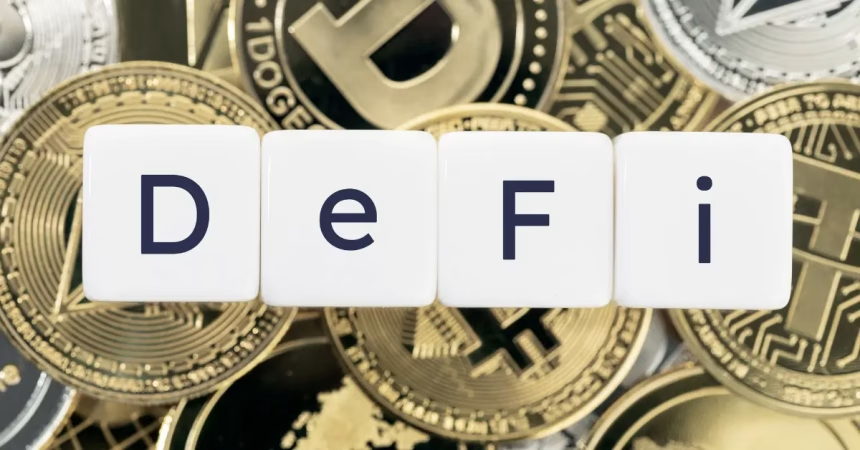
Money isn’t just in banks and government systems anymore, thanks to technology. Decentralized Finance, or DeFi for short, is a new financial revolution that has begun. It lets people borrow, lend, trade, and earn interest without having to go through a bank or other middleman.
Blockchain technology powers DeFi, which means that every transaction is clear, safe, and available to everyone. In traditional finance, banks control your money, but in DeFi, you have complete control over your money. It’s quick, available to everyone with an internet connection, and works all over the world.
This guide for beginners will teach you what DeFi is, how it works, its pros and cons, and why it is thought to be the future of finance. This guide will help you understand DeFi in the simplest way possible, whether you are new to crypto or just want to learn more about this growing trend.
Understanding Decentralized Finance (DeFi)
DeFi, or decentralized finance, is a new way to handle money using blockchain technology. In other words, it makes it unnecessary to use banks, brokers, or any other financial institution. You don’t have to trust a bank to handle your money. Instead, you use smart contracts that automatically carry out transactions when certain conditions are met.
The goal of DeFi is to give people financial freedom by letting them use services like lending, borrowing, trading, and saving directly, without having to rely on traditional systems. Most of the time, everything happens on a decentralized network that is built on the Ethereum blockchain.
Anyone in the world can take part in DeFi as long as they have a crypto wallet and an internet connection. No approvals, paperwork, or waiting times are needed. One of the main reasons DeFi is growing so quickly among crypto users and investors is that it is open and has no borders.
How Does Decentralized Finance Work?
Ethereum is the main blockchain technology that DeFi uses. It uses smart contracts, which are programs that run on their own and finish transactions when certain conditions are met.
There is no central authority in DeFi; everything happens between people. With decentralized apps (DApps), you can lend, borrow, or trade crypto directly. These apps make money matters faster, safer, and available to everyone.
Benefits of Decentralized Finance
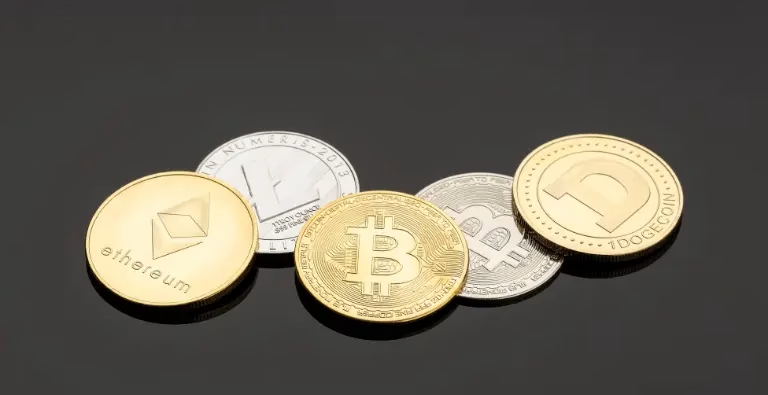
Compared to the traditional banking system, decentralized finance (DeFi) has a lot of benefits. You have full control over your money, which is the best thing about it. No bank or middleman can stop or freeze your funds.
DeFi is also available to everyone around the world, so anyone with a crypto wallet can use it at any time and from any place. Blockchain technology makes transactions quick, clear, and cheap. Users can also make money without doing anything by lending, staking, and yield farming.
Risks and Challenges in DeFi
There are some risks that come with decentralized finance (DeFi), even though it has many benefits. The most important thing is safety. If a smart contract has a bug or mistake, hackers can steal money.
DeFi is also very unstable because it relies on cryptocurrencies, which can change value quickly. Another problem is that there aren’t any rules, so if something goes wrong, you won’t be protected by the law.
Popular DeFi Applications and Platforms
There are a lot of useful platforms in the DeFi ecosystem that offer a variety of financial services. Uniswap, Aave, Compound, and MakerDAO are some of the most well-known ones.
People can trade tokens, lend or borrow crypto, and earn interest without banks on these platforms. Smart contracts power each project, which makes transactions clear and automatic.
The main reason decentralized finance is growing so quickly around the world is because of DeFi apps.
How to Get Started with DeFi
You might think that getting started with DeFi is hard, but it’s not. You need a crypto wallet like MetaMask first. After that, you can link it to DeFi apps (DApps) to lend, borrow, or trade tokens.
Before you put money into something, always start small and do your research. To stay safe, look at the platform’s reputation, the security of its smart contracts, and what other users have to say about it.
As you get better, you can start to look into more advanced DeFi options like yield farming or staking.
The Future of Decentralized Finance
DeFi has a bright future ahead of it. More people and businesses are looking into decentralized ways to lend, pay, and trade. Layer-2 scaling, cross-chain platforms, and DeFi insurance are just a few of the new ideas that will make it safer and faster.
Experts say that DeFi could change the way traditional finance works by making it easier for everyone to see, access, and manage their money.
READ ALSO: What is Cryptocurrency? The Ultimate Beginner’s Guide
Conclusion
The concept of Decentralized Finance (DeFi) is transforming our understanding of money. Without depending on banks, it provides global access, transparency, and control. But there are risks associated with it as well, such as volatility and security problems.
DeFi is exciting for novices, but it should be used with caution. It can be a potent tool for managing and increasing your wealth if you do your homework and invest carefully.
DeFi is a step toward a more transparent and inclusive financial future, not just a passing fad.
Disclaimer
This article’s content is only meant to be educational. This is not financial advice. Investing in DeFi and cryptocurrencies comes with risks, such as losing money. Do your own research and only put in money you can afford to lose.