

Hello friends
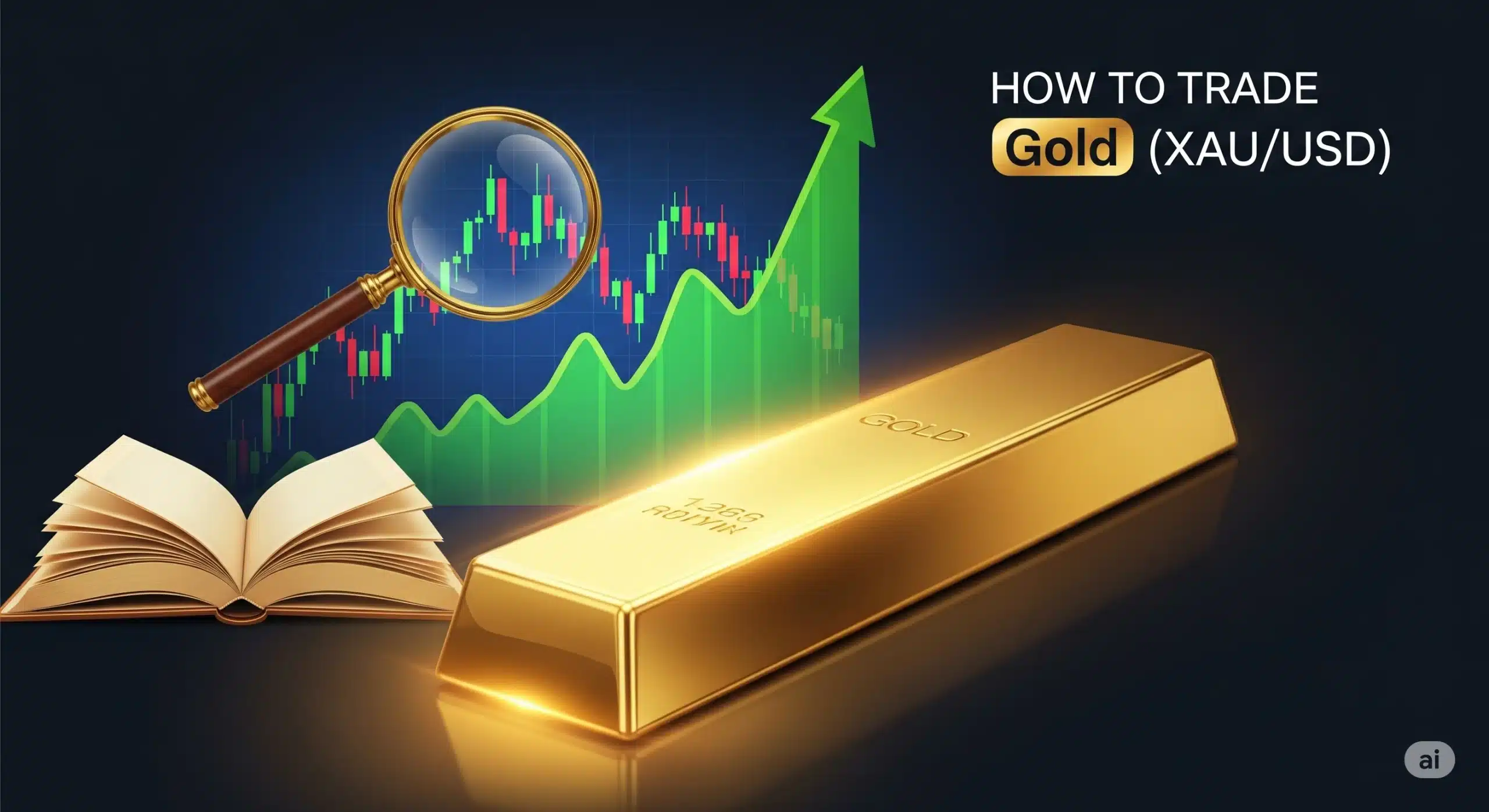
Gold isn’t just a shiny yellow metal; it has been a symbol of wealth, power, and stability for centuries. From ancient civilizations to today’s modern financial markets, gold has never lost its luster. Today, it stands as one of the most attractive and popular trading instruments for traders worldwide. Whenever there’s global economic turmoil or the stock market takes a nosedive, investors and traders flock to gold in search of a safe haven.
Do you want to be a part of this exciting market? Are you curious about how you can profit from the fluctuations in gold prices? If so, you’re in exactly the right place.
This article isn’t just a simple guide; it’s your complete roadmap to the world of gold trading. We’ll guide you through every step, from absolute beginner to an informed trader. We’ll start with the fundamentals of gold trading (XAU/USD), uncover the deep-seated secrets that influence its price, and equip you with powerful trading strategies and unbreakable risk management rules.
By the end of this article, you’ll not only have the theoretical knowledge but also the practical understanding you need to confidently place your first gold trade. So, let’s begin this golden journey!
The World of Gold Trading – Fundamentals and Foundations
Before constructing any building, its foundation must be strong. Before stepping into the world of gold trading, it’s crucial to understand its fundamental principles.
What Does XAU/USD Really Mean?
When you look for “Gold” on your trading platform, you’ll almost always find it listed as XAU/USD. Let’s break this down:
- XAU: This is the official international code for gold, assigned under the ISO 4217 standard. In this, “XA” is used for non-national items (assets without a country), and “U” is derived from gold’s Latin name, ‘Aurum’.
- USD: This is the code for the United States Dollar, the world’s most dominant reserve currency.
When these two come together, XAU/USD acts like a currency pair. It tells us how many US Dollars are required to purchase one Troy Ounce of gold. (Note: Precious metals are measured in Troy Ounces, which are slightly heavier than standard ounces).
For example, if the price of XAU/USD is $2350.50, it means you need to pay 2350.50 US dollars to buy one troy ounce of gold.
Pips, Lot Size, and Leverage – The Three Pillars of Trading
Trading without understanding these three concepts is like shooting an arrow in the dark.
Pips and Ticks:
“Pip” stands for “Point in Percentage.” It is the unit of measurement for the smallest change in price. For most currency pairs, it’s the fourth decimal place. For gold, the calculation is slightly different.
- In the price of gold, the first digit after the decimal point represents one pip.
- Example: If the price of gold moves from $2350.50 to $2350.60, this is a 1-pip move.
- The second digit after the decimal is called a pipette or a tick, which is one-tenth of a pip.
Lot Size:
The lot size determines the volume of gold you are buying or selling in a trade. It directly affects your profit and loss.
- Standard Lot (1.00): This is equal to 100 troy ounces of gold. For every $1 move in the price, you make or lose $100. This is for large and experienced traders.
- Mini Lot (0.10): This is equal to 10 troy ounces of gold. For every $1 move in the price, you make or lose $10. This is suitable for intermediate traders.
- Micro Lot (0.01): This is equal to 1 troy ounce of gold. For every $1 move in the price, you make or lose $1. This is the best option for beginners as it carries the lowest risk.
Leverage:
Leverage is a double-edged sword. It is a type of loan provided by the broker that allows you to control a much larger position with your deposited capital. It is often expressed in ratios like 1:100, 1:200.
Example: A 1:100 leverage means that for every $1 in your account, you can control a trading position of $100. So, with a $1000 account, you could open a position up to $100,000.
Advantage: Leverage can multiply your profits significantly.
Danger: It can also multiply your losses just as quickly. If a trade goes against you, you can lose your entire capital very fast.
Advice for Beginners: Always use low leverage and do not take large positions before you understand it well.
Why is Gold So Special? Its Identity as a Unique Asset
Gold isn’t just another commodity. It has a unique character that sets it apart from all other financial instruments. Understanding why gold is so special will help you better comprehend its movements.
The Ultimate Safe-Haven
A “safe-haven” is an asset that is expected to retain or increase its value during times of economic crisis. Gold is the king of this category.
- Historical Evidence:
- The 2008 Financial Crisis: When stock markets around the world collapsed, the price of gold saw a massive rally.
- The COVID-19 Pandemic: In early 2020, amidst lockdowns and uncertainty, the price of gold reached its all-time high.
- Why does this happen? When investors lose faith in stocks, bonds, and currencies, they want to put their money into something that has been valuable for thousands of years – and that is gold. It is a barometer of fear and uncertainty.
The Inflation Hedge
Inflation slowly eats away at the purchasing power of your currency. An item that costs $100 today might cost $120 in a few years.
Gold acts as a shield against inflation. When the value of money decreases, more currency is required to buy the same amount of gold, which causes the price of gold to rise. It helps in preserving the value of your wealth over the long term.
High Liquidity and Volatility
- Liquidity: The gold market is very large and active. This means there are millions of buyers and sellers at all times. High liquidity ensures that you can easily enter and exit your positions at any time without significantly affecting the price.
- Volatility: The price of gold experiences significant fluctuations throughout the day. For a trader, volatility is like a friend. It is these price movements that create opportunities to make a profit. Gold’s Average Daily Range is often $20-$40 or even more, providing attractive opportunities for day traders and swing traders.
Low Correlation with Other Assets
Another great feature of gold is that it often moves independently of other major asset classes like stocks and bonds. Often, when the stock market goes up, gold remains stable or goes down, and when the stock market falls, gold goes up. Because of this low correlation, large investors use gold to balance their portfolios and reduce risk.
The Forces Behind Gold’s Price – Who Moves the Market?
The price of gold doesn’t move on its own. Behind it is a complex dance of global economic forces, geopolitical events, and human emotions. To become a successful gold trader, understanding these forces is mandatory.
The US Dollar (DXY) – Gold’s Arch-Nemesis
There is an inverse relationship between gold and the US dollar. This is the most important relationship you need to remember.
Why? Because gold is priced in US dollars.
- When the dollar is strong, it becomes more expensive for people in other countries to buy gold, which reduces its demand and causes the price to fall.
- When the dollar is weak, gold becomes cheaper for other currency holders, which increases both its demand and price.
Pro Tip: Always keep an eye on the DXY (US Dollar Index). This index measures the strength of the dollar against a basket of six major world currencies. If the DXY is rising, you might see pressure on XAU/USD, and if the DXY is falling, XAU/USD might find support.
nterest Rates and Monetary Policy – The Shadow of the Federal Reserve
The policies of central banks, especially the US Federal Reserve (The Fed), have a profound impact on the price of gold.
- Real Interest Rates: This is the most critical factor.
Real Interest Rate = Nominal Interest Rate – Inflation Rate
Gold does not pay any interest or dividends. When real interest rates rise, interest-bearing assets like government bonds become more attractive, and investors sell gold to put their money there.
When real interest rates are low or negative, there is no benefit to holding money in bonds. Investors then put their money in gold, causing its price to rise.
- Quantitative Easing (QE): When a central bank injects money into the market (prints money) to stimulate the economy, it devalues the currency and increases the fear of inflation – this is very positive for gold.
- Quantitative Tightening (QT): When a central bank withdraws money from the market, it can be negative for gold.
Geopolitical Tensions – The Fear Gauge
Gold reacts to any major turmoil in the world. Wars, terrorist attacks, trade wars, or political instability in a major country – all these events create a “risk-off” sentiment in the market. At such times, investors rush towards gold in search of a safe investment, causing a sudden spike in its demand and price.
Central Bank Demand – The Whales of the Market
Central banks around the world hold a portion of their foreign exchange reserves in the form of gold. In recent years, central banks of emerging markets like China, Russia, and India have been buying massive amounts of gold to reduce their dependency on the US dollar. When central banks buy gold on a large scale, it sends a strong signal to the market and supports the price. Keeping an eye on reports from the World Gold Council can be useful to understand what central banks are doing.
Analyzing the Gold Chart – A Trader’s Toolkit
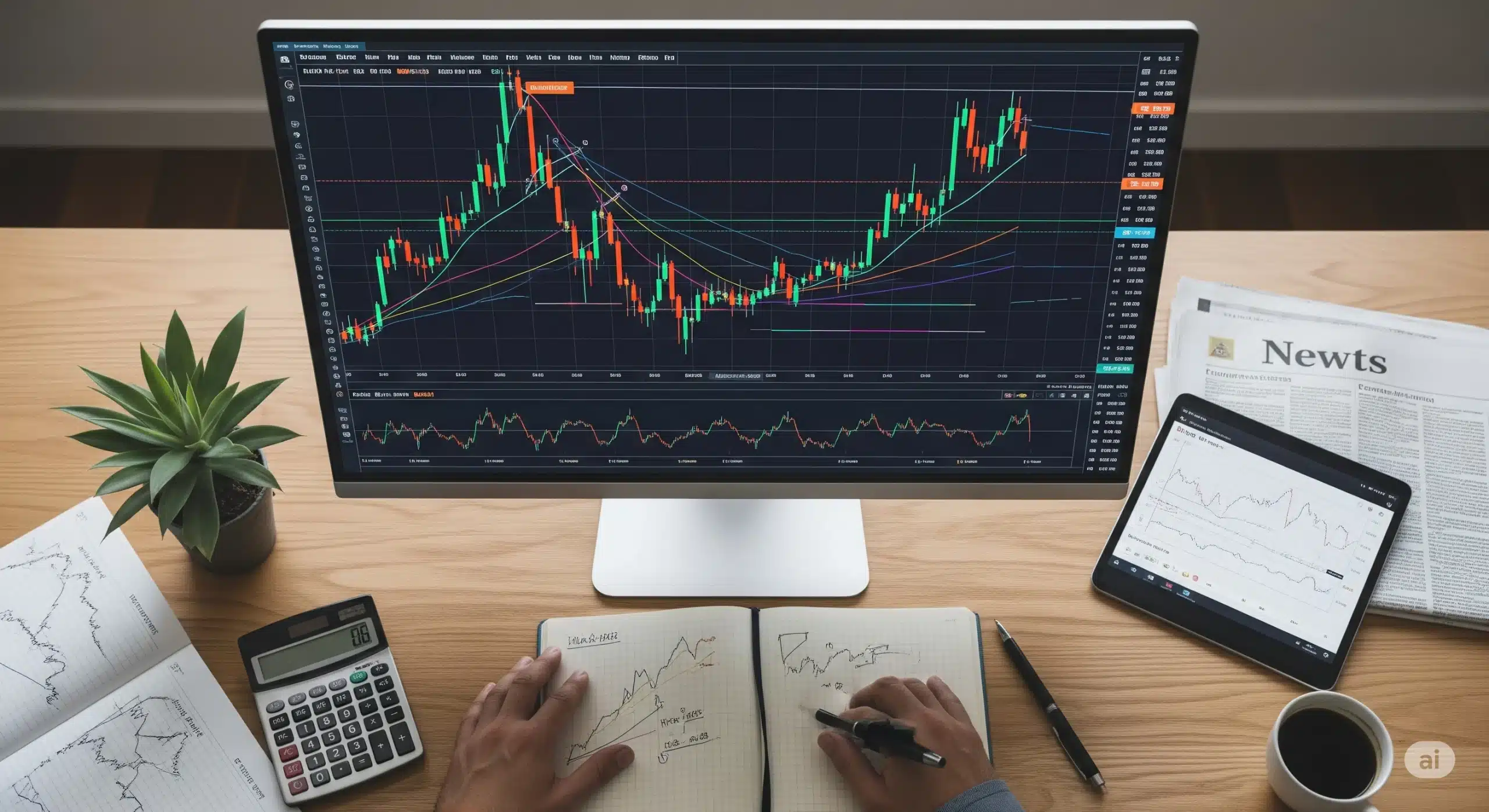
Now that you know why the price of gold moves, the next step is to learn how to analyze and predict these movements. There are two main approaches for this: technical analysis and fundamental analysis.
The Art of Technical Analysis
Technical analysis believes that all price information is available on the chart itself. It involves studying historical price data to predict future patterns.
Understanding Charts:
- Candlestick Chart: This is the most popular among traders. Each ‘candle’ tells the complete story of the price within a specific time period (like 1 hour or 1 day):
- Body: The difference between the opening and closing price. A green candle means the price increased, and a red candle means the price decreased.
- Wicks/Shadows: They represent the highest and lowest prices of that period.
Important Chart Patterns:
Some frequently forming patterns on the chart can indicate the future direction of the price.
- Head and Shoulders: This is a trend reversal pattern that signals the end of an uptrend.
- Double Top / Double Bottom: These are also trend reversal patterns that signal the end of an uptrend or downtrend, respectively.
- Triangles and Flags: These are ‘continuation’ patterns, which indicate that the current trend may resume after a short pause.
Key Indicators:
Indicators are mathematical calculations that you can apply to your chart to better understand trend, momentum, and volatility.
- Moving Averages (MA): A line that represents the average price over a specific period.
- Golden Cross: When a short-term MA (like the 50-day) crosses a long-term MA (like the 200-day) from below – it’s a bullish signal.
- Death Cross: When the 50-day MA crosses the 200-day MA from above – it’s a bearish signal.
- Relative Strength Index (RSI): A momentum oscillator that ranges between 0 and 100.
- Above 70: Overbought – the price has risen too much, and a pullback or reversal is likely.
- Below 30: Oversold – the price has fallen too much, and a bounce-back is likely.
The Power of Fundamental Analysis
Fundamental analysis focuses on the ‘why’. It tries to determine the intrinsic value of gold by analyzing economic data, news, and global events.
- Sentiment Analysis:
- COT Report (Commitment of Traders): This weekly report shows what large institutional investors (smart money) are doing in the market – are they buying or selling?
- Fear & Greed Index: This measures the level of fear and greed in the market, which can help you understand if the market is becoming overly optimistic or pessimistic.
A Balanced Approach: The most successful traders use a combination of both technical and fundamental analysis. Fundamental analysis tells you ‘what’ to trade and ‘why’ to trade it, while technical analysis tells you ‘when’ to trade (the right entry and exit points).
Building Your Gold Trading Strategy
Now that you have the tools for analysis, it’s time to weave them into a coherent trading strategy. There is no such thing as the “best” strategy; the best strategy is the one that suits your personality, risk tolerance, and lifestyle.
Different Trading Styles:
- Scalping:
- Duration: Seconds to minutes.
- Goal: To make quick profits from very small price movements (a few pips).
- Description: Scalpers make dozens of trades a day. This requires extreme focus, discipline, and a broker with low spreads. It is not recommended for beginners.
- Day Trading:
- Duration: Minutes to hours.
- Goal: To open and close trades within the same day, holding no positions overnight.
- Description: Day traders take advantage of price swings during the day, especially when major market sessions like London and New York overlap, as volatility is highest then.
- Swing Trading:
- Duration: A few days to a few weeks.
- Goal: To capture larger price “swings”.
- Description: Swing traders use daily or 4-hour charts and trade from major support and resistance levels. This is a popular style for those who cannot watch the charts every minute.
- Position Trading:
- Duration: A few weeks to months or years.
- Goal: To profit from long-term fundamental trends.
- Description: Position traders focus mainly on fundamental analysis and are not concerned with short-term price fluctuations.
Risk Management – Your Shield of Protection
This is the most important chapter in this entire guide. You can know the best trading strategy in the world, but if your risk management is weak, you will eventually lose all your money. Success in trading doesn’t depend on how much you win, but on how little you lose when you are wrong.
The Golden Rule of 1-2%
This rule states that you should never risk more than 1% to 2% of your total trading capital on any single trade.
6.2 Stop-Loss: Your Mandatory Safety Net
A Stop-Loss is an automatic order that instructs your broker to close your position at a pre-determined price to limit your losses. Trading without a stop-loss is like driving a car with no brakes.
Position Sizing Calculation
Your risk is determined by your stop-loss, and your stop-loss determines your lot size (position size). You must calculate the correct position size to adhere to the 1-2% rule.
Risk-to-Reward Ratio (RRR)
This ratio measures how much you are risking for a potential profit. A good rule of thumb is to maintain an RRR of at least 1:2.
Why? If your RRR is 1:2, you only need to be right more than 33% of the time to be profitable in the long run. This takes the pressure off you and prevents you from feeling like you have to win every trade.
Trading Psychology: Conquering Your Biggest Enemy
In trading, your biggest enemy is not the market; it is you. Two main emotions can dominate your decision-making: Greed and Fear.
- Greed can push you to take huge risks, hold on to a winning trade for too long, or trade too frequently.
- Fear can stop you from taking a good opportunity (FOMO – Fear of Missing Out), or make you exit a losing trade too early.
The best way to manage these emotions is to create a detailed trading plan and stick to it strictly in every situation.
Your First Gold Trade – Practical Steps
Now it’s time to put theory into practice.
- Choosing a Good Broker:
- Regulation: Ensure the broker is regulated by a top-tier agency like FCA (UK), ASIC (Australia), or CySEC (Cyprus).
- Trading Costs: Compare spreads, commissions, and swap fees (fees for holding positions overnight).
- Platform: Make sure their platform (like MetaTrader 4 or 5) is stable and user-friendly.
- Practice on a Demo Account:
Before risking real money, practice on a demo account for at least a few weeks or a month. Test your strategy, get familiar with the platform, and don’t be afraid to make mistakes.
- Start Small:
When you start live trading, begin with a very small amount of capital. Use microlots (0.01). Your first goal is not to make money, but to not lose money and to gain experience.
A Journey of Continuous Learning

Gold trading is not a “get rich quick” scheme. It is a serious business that requires skill, patience, and discipline. This guide provides a strong foundation, but the real learning will come with experience in the market.
Always remain a student. Study the markets, learn from your mistakes, and constantly refine your strategies. Keep a trading journal – write down your wins, your losses, and the reasons behind them.
Remember, gold trading is a marathon, not a sprint. By making risk management your top priority and adopting a disciplined approach, you can pave the way for long-term success in this exciting market. Seize this golden opportunity and begin your trading journey with confidence.
READ ALSO: what is Leverage and margin in forex trading for beginners explained 2025
Frequently Asked Questions (FAQ)
Q1: What is the best time to trade gold?
Answer: The best time to trade gold is when the market has the most volatility and liquidity. This usually occurs during the overlap of the London and New York trading sessions, which is approximately from 6:30 PM to 10:30 PM Indian Standard Time (IST).
Q2: Can I start gold trading with $100?
Answer: Yes, many brokers now offer “cent” or “micro” accounts where you can start with $100 or even less. However, you should always use microlots (0.01) and have realistic profit expectations.
Q3: Is gold (XAU/USD) trading legal in India?
Answer: Forex and CFD trading fall into a regulatory grey area in India. SEBI-regulated Indian brokers do not allow you to trade XAU/USD. Indian residents often use international brokers, which involves its own set of risks and may have complications under FEMA regulations. It’s best to consult a financial advisor before investing.
Q4: How profitable can gold trading be?
Answer: Profitability has no limit, but it entirely depends on your strategy, risk management, capital, and skill. Setting realistic goals is crucial. Many professional traders consider a monthly return of 5-10% to be an excellent result. Expecting to get rich overnight often leads to significant losses.