


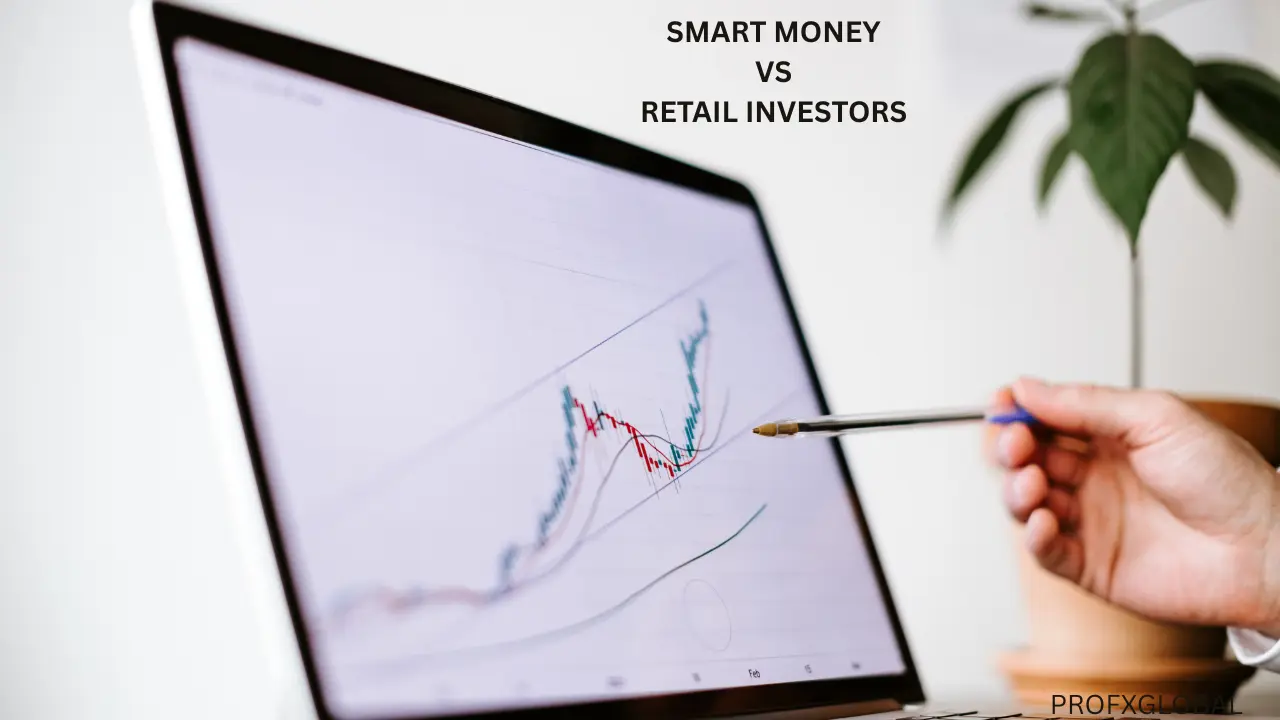
There has always been a debate in the world of financial markets about smart money vs retail investors. Institutional investors, hedge funds, and professional traders who have access to deep research, technology, and big capital are what “smart money” used to mean. On the other hand, “retail investors” are regular people who use their own money to buy or sell stocks, forex, or crypto.
But things are changing. Over the past few years, retail investors have become more numerous and powerful. Retail isn’t as weak as it used to be because it’s easy to get to trading apps, free research tools, and social media groups. This makes me think of an important question: Is retail slowly becoming the new smart money?
In this article, we’ll talk about the differences, strategies, psychology, and recent trends between smart money and retail investors in a way that is easy to understand.
What is Smart Money
When we use the term “smart money,” we usually mean the professional side of trading and investing. These are not individual traders; they are big banks and other financial institutions with a lot of money and sophisticated strategies. Some examples of smart money players are:
Smart money is considered “smart” because these institutions have certain advantages that retail investors do not. They have:
- Hedge Funds
- Mutual Funds
- Pension Funds
- Investment Banks
- Big Corporate Investors
- Access to cutting-edge tools like AI-powered trading systems, high-frequency algorithms, and research reports that are only available to insiders.
- They have a lot of money, which lets them move markets by buying or selling a lot of things at once.
- Analysts, economists, and fund managers are just some of the experts who work in dedicated teams to study global market trends in depth.
- The power to affect stock prices through strategic investments, accumulation, or distribution phases.
For instance, when a big mutual fund puts a lot of money into a stock, it usually means that they trust that company. Because of this, other investors, like retail traders, do the same thing, and the stock price goes up. When we look at smart money and retail investors, this shows how different their influence is. Smart money usually goes first, and retail follows.
- You can trade through apps like Zerodha, Groww, Upstox, and Robinhood.
- Usually don’t have as much money as institutions.
- Use the news, social media, or basic technical analysis.
- People often trade based on how they feel, like fear of missing out (FOMO) or panic selling.
Who are Retail Investors?
Smart money vs retail investors are two sides of the same coin. Retail investors are regular people who use their own money to buy stocks, forex, mutual funds, commodities, or cryptocurrencies. Even though each of their businesses is small, they are the backbone of markets because there are so many of them. Most people who invest in the stock market do so through online platforms like Zerodha, Groww, Upstox, or Robinhood. They don’t usually do in-depth research or have a lot of money like institutions do. Instead, they rely on basic tools, news, or social media trends.
Smart Money vs Retail Investors-Key Differences
| Factor | Smart Money | Retail Investors |
|---|---|---|
| Capital | Huge capital in crores/billions | Limited, personal savings |
| Research | In-depth, data-driven, professional analysts | News, social media, personal research |
| Psychology | Long-term, disciplined | Emotional, short-term focus |
| Market Impact | Can move markets | Usually follow trends |
| Tools | Advanced AI, algorithms, insider info | Basic apps & free charts |
Why is Smart Money Considered Powerful?
Smart money is important in financial markets because it can change prices and manage risks better than regular investors. Let’s break it down:
- Power to Move the Market – A big change in stock price can happen when an institutional fund, such as a hedge fund or mutual fund, places a single bulk order. For instance, when they buy a lot of shares all at once, demand goes up and retail investors often follow, which drives the price up.
- Better Risk Management: Smart money uses advanced tools like futures, options, and derivatives to protect their positions, while most retail investors just buy and sell. This means that they are safe from big losses even if one trade goes wrong.
- Insider Access: Institutions often get information early through research reports, management meetings, or analyst calls that regular investors can’t easily get. This edge in information helps them make better choices.
- Long-Term Patience: Many retail investors panic when the market is volatile in the short term, but smart money usually invests with a time frame of years. They focus on long-term returns, which helps them stay calm when the market goes up and down and lets them take advantage of compounding.
In short, smart money is strong because it has three things that retail investors often don’t: capital, information, and discipline. Read More Related article: Smart Money Concepts (SMC) for Traders
How Retail Investors are Evolving in 2025
In the past, retail investors were thought to be the “weaker hand” in the markets. But now, a lot more people are buying things, especially in India and the US. Some reasons are:
- The rise of discount brokers: Apps like Zerodha, Groww, and Robinhood made it easy to trade.
- Twitter, Telegram, and YouTube are all social media sites where people can share information right away.
- Financial Literacy: More young people know about the stock market than ever before.
- Low Entry Barriers: You can start investing today with just ₹500 or $10.
A lot of the daily trading on the stock market is now done by individual investors. This means that together they can change prices in a short amount of time.
Is Retail Becoming the New Smart Money?
A number of studies and expert opinions show that retail investors are getting smarter and more sure of themselves.
- Retail investors bought a lot when the markets crashed during COVID-19 and then sold for big profits later.
- Reports from 2025 say that retail investors are leading some rallies, and institutions sometimes have to follow what they do.
- Sandeep Tandon, a market expert, even said that retail investors are now more confident than many high-net-worth investors (HNIs).
- Retail investors have become the main force behind tech stock rallies in the US markets, which has caused “smart money” to follow their lead.
This change in the relationship between smart money vs retail investors shows that retail investors are no longer just following—they are also setting trends and having more of an impact on global markets.
Trading Psychology: Smart Money vs Retail Investors
Trading Psychology: The Difference Between Smart Money vs Retail Investors
- Smart Money Psychology: Be patient, stick to your plan, and think about how your money will grow over time.
- Retail psychology: emotional, often based on fear or greed, but gets better with more knowledge.
For example, retail investors used to panic and sell when markets fell suddenly. But in the last few years, a lot of retail investors have been holding onto their stocks and buying when prices drop, just like big institutions. According to The Economic Times, retail investors are now seen as more confident than even some high-net-worth investors, showing how their behavior is evolving.
Strategies Smart Money Uses
- They buy in small amounts before a big move, which helps them build up and spread out.
- When you hedge, you use options and futures to lower your risk.
- Algorithmic Trading: Making small amounts of money with AI and automation.
- Insider Advantage: Getting information about the company before anyone else.
Strategies Retail Investors Can Use to Become “Smart”
- Focus on Learning -Basic financial knowledge, charts, risk management.
- Avoid Emotional Trading – No panic selling, no chasing hype.
- Follow Smart Money Activity -Track bulk deals, FII/DII data, options chain.
- Long-Term Vision -Instead of daily gambling, focus on quality investments.
Challenges for Retail Investors
Even though retail investors are growing, they still face some issues:
- Lack of professional research access.
- Easily influenced by fake tips on social media.
- Over-trading without proper risk management.
- Small capital limits diversification.
Future Outlook: Finding the Right Balance Between Smart Money and Retail
Markets may not only be about smart money and retail investors in the future. It might become a balance instead:
- Long-term moves will still be led by institutions.
- Short-term rallies and trends will be more and more affected by retail investors.
- Technology, AI, and education will help the two groups get along better.
To put it simply, retail investors aren’t fully smart money yet, but they are definitely smarter than they used to be.
Conclusion
It’s not just about who has more money or power when people talk about smart money vs retail investors. It’s about strategy, psychology, and having the right information.
Smart money still has benefits like in-depth research, a lot of money, and power.
But retail investors are no longer weak; technology, knowledge, and working together are helping them get stronger.
Retail investors may not completely replace smart money in 2025 and beyond, but they are definitely becoming the new power in the financial markets.
So, if you are a retail trader or investor, the lesson is clear: Be smart, stick to your rules, and keep learning. That’s what it really means to be “smart money.”
DISCLAIMER
The information provided in this article on smart money vs retail investors is for educational purposes only and should not be considered financial or investment advice. Stock market and trading decisions involve risk, and past trends may not guarantee future results. Readers are advised to do their own research or consult a certified financial advisor before making any investment decisions.